

Memory Matters Weekly #23: what cooking oil might have to do with dementia risk, an AI tool that could help identify Alzheimer’s earlier, and a large Oxford study on cannabis that may reassure many older adults. Three very different studies.
Published 07 March 2026 -Issue #23
3 Quick Bites: Last Week in Dementia News
Could the oil in your kitchen help protect your brain?
Higher linoleic omega-6 fatty acid intake linked to lower dementia risk, large study finds – Nutrition Insight, 2 March 2026 • Read it here
Story
Blood samples and health records from more than 273,000 UK adults, tracked for up to 15 years, showed that those with higher levels of linoleic acid, an omega-6 fat found in sunflower, corn and soybean oils, as well as nuts and seeds, had an 18% lower risk of dementia.
In contrast, higher levels of a different omega-6 fatty acid, found in smaller amounts in animal foods like meat, eggs and poultry (rather than the higher levels typically coming from plant oils, nuts and seeds, were linked to a 21% higher dementia risk.
Why it matters
You’ve probably heard a lot of confusing messages about fats over the years. Good fats, bad fats, omega-3s, omega-6s. It can be hard to know what to do with any of it.
This study is useful because it makes a clearer distinction. Not all omega-6 fats behave the same way. The kind commonly found in plant oils was associated with lower dementia risk, while the type more concentrated in lower amounts in certain animal foods showed the opposite pattern.
Diet is one of the few areas where people feel they have some influence over long-term brain health, so findings like this are worth keeping in mind.
My take
This is a genuinely large and well-conducted study, which gives the findings some weight. The important caveat, and the researchers are clear about this, is that it’s observational. That means it shows a strong association but cannot prove that eating more sunflower oil directly prevents dementia.
It could simply be that people who consume more plant oils also tend to have healthier diets and lifestyles overall. Still, the results add to a growing picture: dietary patterns similar to the Mediterranean diet, rich in plant oils, nuts and seeds, consistently look positive for brain health.
Could AI predict how quickly Alzheimer’s will progress?
Researchers say AI can predict Alzheimer’s disease with close to 93 percent accuracy – The Independent, 6 March 2026 • Read it here
Story
Scientists have developed an AI tool that can predict, with around 93% accuracy, whether someone showing early signs of memory and thinking problems will go on to develop Alzheimer’s disease and how quickly their symptoms may progress. The system was tested using data from memory clinic patients in the UK and Singapore. It can also group patients into three likely trajectories: those whose symptoms remain stable, those who decline slowly, and those whose condition is likely to worsen more quickly.
Why it matters
One of the hardest parts of the early diagnosis journey is the waiting and the uncertainty. Current tests are often expensive, invasive, and still leave families without a clear picture of what lies ahead. A tool like this, if it reaches everyday memory clinics, could change that significantly. Earlier clarity gives families more time to plan, to access the right support, and potentially to receive help from treatments at the point they work best.
My take
What makes this study more convincing is that the system was tested on real memory clinic patients rather than only in a controlled research dataset. That gives the results more weight than a lot of AI research we see. At the same time, tools like this are rarely ready for immediate clinical use. AI models often perform well in research but still need to prove they work consistently across different hospitals, populations and healthcare systems. The fact it was validated on hundreds of real patients across more than one country is encouraging though. It suggests this kind of tool may eventually become part of how dementia is assessed, even if that is still a few years away.
Does cannabis harm memory as we age? A large Oxford study looked at the data.
Study finds no links between cannabis use and cognitive decline or dementia in older people – Oxford Population Health, 25 Feb 2026 • Read it here
Story
Oxford researchers compared nearly 19,000 cannabis users with non-users across five cognitive tests using UK Biobank data and a large US veterans’ programme. They found no evidence that cannabis use was linked to poorer cognitive performance or increased dementia risk in older adults. Cannabis users performed slightly better on some tests, but the researchers say this likely reflects differences in education and socioeconomic status rather than any cognitive benefit from cannabis itself.
Why it matters
Cannabis use among older adults is rising, driven by legalisation in many countries and its increasing use for pain, sleep and anxiety. For those using it moderately, this study offers some reassurance on the question of dementia and cognitive decline.
My take
The limitations are these:The UK Biobank group tends to be healthier than the general population, which can influence results, and the US group was identified by a formal diagnosis of ‘cannabis use disorder’, which skews towards heavier users. Neither captures the full picture of typical use. The researchers also couldn’t measure potency or how the cannabis was used, which matters a lot given how much stronger modern cannabis can be. What it does highlight is the need for better long-term research as patterns of cannabis use continue to change.
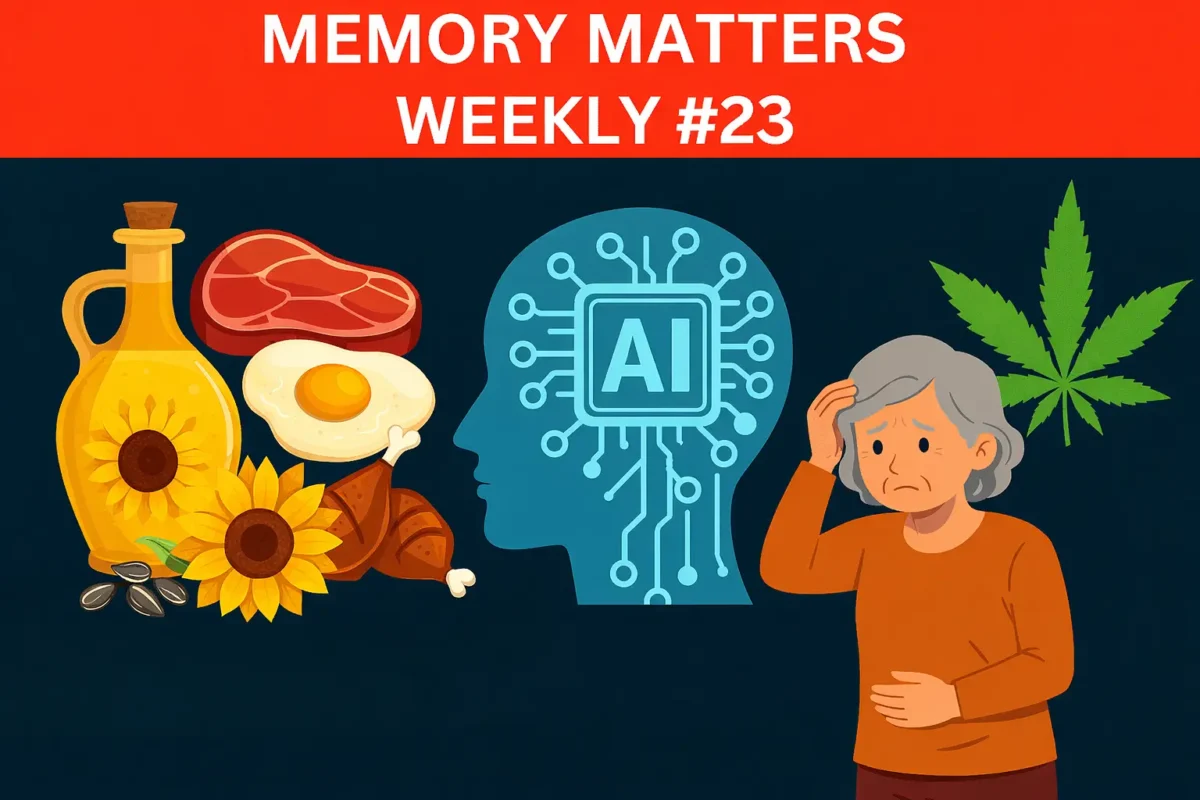
Bringing it together
These three stories show how wide the dementia research landscape has become. Scientists are exploring everything from the nutrients circulating in our blood to artificial intelligence systems analysing medical data, while also examining how lifestyle choices may influence long-term brain health. None of these studies provide final answers on their own. What they offer are signals and patterns that help researchers build a clearer understanding of how dementia develops and how it might eventually be prevented or detected earlier.