
As a former caregiver, I know how overwhelming the early days can be. That is why this year’s World Alzheimer’s Day 2025 theme, “Ask about Dementia. Ask about Alzheimer’s,” is so important.
I joined a webinar after reading a post from dementia care expert, Jackie Pool about the launch of the World Alzheimer Report 2025 called “Reimagining life with dementia – the power of rehabilitation.” that asked important questions that I hadn’t thought about.
Have you ever wondered why rehabilitation is offered after a stroke, a broken hip, or a heart attack, but not after a dementia diagnosis?
Why is that?
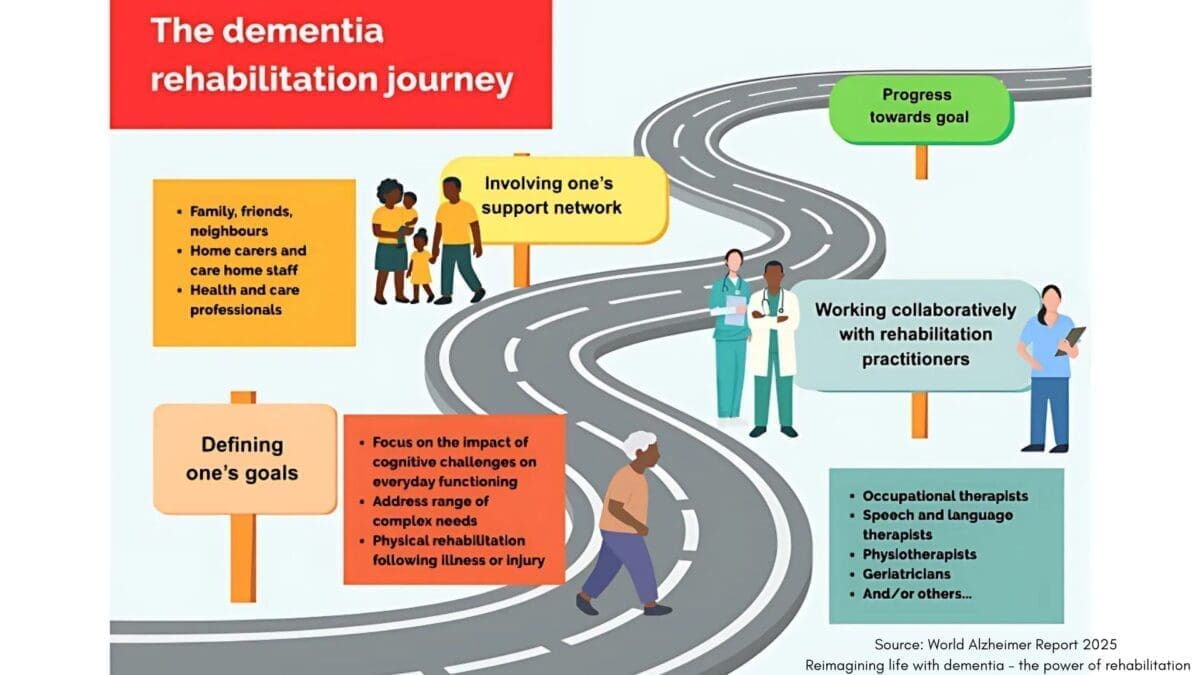
The report’s main point is surprisingly simple: people living with dementia can still set goals, learn strategies, and adapt their lives with the right support through rehabilitation.
Dementia isn’t a one size fits all syndrome, everyone is different.
That’s why rehabilitation is about focusing on what a person can still do and helping them do it for as long as possible.
The report argues that rehabilitation should be part of dementia care just as much as it is for other health conditions.
I see now that many of the questions I didn’t know how to ask are exactly the ones this report helps us with.
Why It Matters to Caregivers
Rehabilitation isn’t just about professionals swooping in. Caregivers are central to the process. We’re the ones who support our loved ones with what matters most to them.
And here’s what struck me: rehabilitation helps both sides.
For the person living with dementia, it means dignity, independence, and a chance to keep doing the things that make them who they are.
For caregivers, it means less pressure on us. When your loved one can walk to the shops safely, or get dressed with a bit of prompting, or use assisted technology then that’s one less task entirely on your shoulders. Our loved ones are enabled to retain or build strategies to maintain their independence.
The smallest adjustments make the biggest difference. Something as simple as putting a large calendar in the kitchen, adding grab bars in the bathroom, or practicing a daily walk together can all be considered part of rehabilitation.
The report talks about research showing that when people with dementia have access to tailored rehabilitation, they can stay at home longer before moving into residential care. Sometimes six months or more. Six months might not sound huge to policymakers, but to us, that’s six more months of being together, at home.
Stories That Bring It to Life
One of the most powerful parts of the launch was hearing from John Quinn & Glenys Petrie who shared their story. It took two years for John to be diagnosed with Alzheimer’s in his fifties, and like so many, he went through a period of depression and withdrawal. Glenys said he spent years staring at four walls. But instead of accepting that as the only path, hope resurfaced after attending a Dementia Australia event in 2016.
Instead of giving up, he and Glenys created their own rehab plan called NAMES focusing on nutrition, attitude, mental activity, exercise, and social engagement. Their story embodies what the report calls for: rehabilitation as collaboration, the person with dementia and their caregiver working side by side.
John explained:
“I reconnected with family, friends, and the community whilst participating in things that I found meaningful. I maintained wellness through a healthy diet. Psychologically, I’d established my autonomy and importantly no longer felt like just another statistic.”
Then there’s Anita, caring for her mum. Her story personally resonated with me, so similar to my own experience. She pulled together a team of therapists, not easy, and tried every strategy going: exercises to improve balance, memory calendars, communication aids. For Anita, it worked, kept her mum in the house she loved, and she felt more confident as a caregiver.
Reading those stories, I thought of how many times we, as caregivers, “make it up as we go”, except here it has a name: rehabilitation.
And it works but not all caregivers have the motivation or know the right questions to ask to get the support loved ones need. That’s why this Alzheimer’s day theme is so important.
Why This Fits World Alzheimer’s Day 2025
Every year on World Alzheimer’s Day, we’re reminded to raise awareness. This year’s theme, “Ask about Dementia. Ask about Alzheimer’s”, is about asking the questions that too often get left unsaid.
That’s why the question of why rehabilitation isn’t routinely part of dementia care is so important.
Because the truth is, many people with dementia are excluded from rehab services, even when they break a hip or have another health problem. Too often, the assumption is that they won’t benefit. This report challenges that thinking.
It says rehabilitation should be a right, not a luxury.
The late author and dementia advocate Wendy Mitchell described in her blog what happened when she broke her wrist and dislocated her shoulder. A consultant told her surgery wasn’t necessary because she had dementia. As she wrote:
Stories like Wendy’s show why rehabilitation needs to be a standard part of dementia care as it is for other forms of illness.
And at all stages of the dementia journey, that came up in the Q&A at the end of the webinar. The earlier the interventions start the better, but Jackie Pool added her perspective as an occupational therapist, and one point she made really stood out: rehabilitation isn’t just for the very early stages.
“Even at moderate dementia people could relearn or learn new ways of doing actions,”
she explained, challenging the idea that it’s “too late” once decline has progressed.
That message matters, because it shows rehabilitation has value across the journey. I know some will disagree.
The Global Picture
Dementia affects people in every country. Yet the report also underlines how little rehabilitation is being used in dementia worldwide. The report calls this out as a major gap and insists it must change.
Rehabilitation truly works, it can improve everyday functioning and even slow the decline in independence.
But….globally, many countries don’t even mention rehabilitation in their dementia plans, and three-quarters of countries still have no plan at all.
And then there is the financial reality.
Globally, informal family care makes up roughly half of all dementia care costs.
That means unpaid caregivers are carrying as much weight as health systems themselves. For those of us who have lived it, that number is no surprise. But seeing it acknowledged at a global level matters.
Small Shifts That Make a Big Difference
The report isn’t just about professionals in labs or hospitals. It’s about things we can bring into our daily routines too.
- Set small goals. Instead of focusing on what’s been lost, think about one thing your loved one still wants to do, and break it down. Folding laundry. Stirring a pot. Calling a friend.
- Adapt the environment. Labels on cupboards. Grab bars in the bathroom. A big clock and calendar in the kitchen. They’re rehabilitation tools but get the right tools that fit your loved ones dementia needs
- Keep moving. Even short walks or chair exercises count. The report reminded me that people with dementia are 2-3 times more likely to fall, but the right support can reduce that risk.
- Stay social. Whether it’s music, a chat group, or visiting a neighbour, connection is just as important as medication.
None of these cost a fortune. But they can delay decline. It’s about doing with, not doing for. Caregivers are at the centre of it. Every time we adapt a task, change an environment, or encourage instead of taking over, we’re already delivering rehabilitation.
The difference is that this report recognises it, lays out various methods and strategies we can use and adapt for ensuring proper support to protect independence and dignity.
Closing Thoughts
I’ll be honest. This report wasn’t written with caregivers like you and me as the main audience. The World Alzheimer Report is designed to influence health systems, policymakers and professionals. That’s why it is full of statistics, global comparisons and economic arguments.
But that’s exactly why I think it matters for us to read it in simpler terms. Most caregivers would never sit down with a 100-plus page report or join a webinar with professors and policymakers. We don’t have the time or the headspace.
Yet tucked inside are the stories, research and evidence that prove what many of us already do instinctively every day is rehabilitation.
John’s words stay with me:
“We had nothing to lose.”
For caregivers, that feels true. I tried things, I adapted, I asked questions every single day.
But sometimes I didn’t know which questions to ask, or I felt I didn’t have the right to ask them.
That’s why World Alzheimer’s Day 2025 theme, “Ask about Dementia. Ask about Alzheimer’s,” couldn’t be more fitting. Because the World Alzheimer Report 2025 gives us the questions we should be asking?
- What rehabilitation strategies are available for my loved one?
- Can I, as a caregiver, be included in setting goals and planning?
- What training or community programmes exist locally?
- What small changes at home could make a big difference?
The more we ask these questions, to doctors, to policymakers, to each other, the more visible rehabilitation becomes.
After all, it is available for other forms of illness so why not for dementia?
In the end, the World Alzheimer Report 2025 delivers an encouraging message, there is a life to be lived after diagnosis, and rehabilitation helps make that life as rich and independent as possible.
We just need to keep asking questions, the right questions, and push to get the support we need, nothing new there eh, for caregivers!
I am so excited, I would love to become a participant. I am a dementia care professional ( author of The Ten Absolutes) and have been diagnosed with dementia, probably of the Alzheimer’s type.
Thanks, that’s great to hear, i can only wish you both the best.