
Memory Matters Weekly #29
One of the biggest dementia stories in years dropped this week and the way it was reported may have left you feeling confused.
It made headlines across the BBC, the Guardian, and most of the big outlets. A new scientific review concluded that Alzheimer’s drugs offer no meaningful benefit. If you’ve been following the slow progress of these treatments with any kind of hope, that’s a shocking thing to read over your morning coffee.
Because for the first time in decades, two drugs, lecanemab and donanemab, made it through large clinical trials, showed real effects on slowing decline, and got licensed. Not on the NHS yet, and not without serious risks but after years of treatments that failed, this felt like the start of something.
So a headline saying it was all for nothing was the worst thing to read, but as always the truth is a bit more complicated than that.
A Cochrane review, from one of the most respected independent research organisations in the world, analysed 17 clinical trials involving more than 20,000 participants across seven different drugs. All of them were designed to clear amyloid, the protein that builds up in the brains of people with Alzheimer’s. Its conclusion was that, across all these drugs, the effects on memory, thinking, and daily functioning were too small to make a meaningful difference to people’s lives.
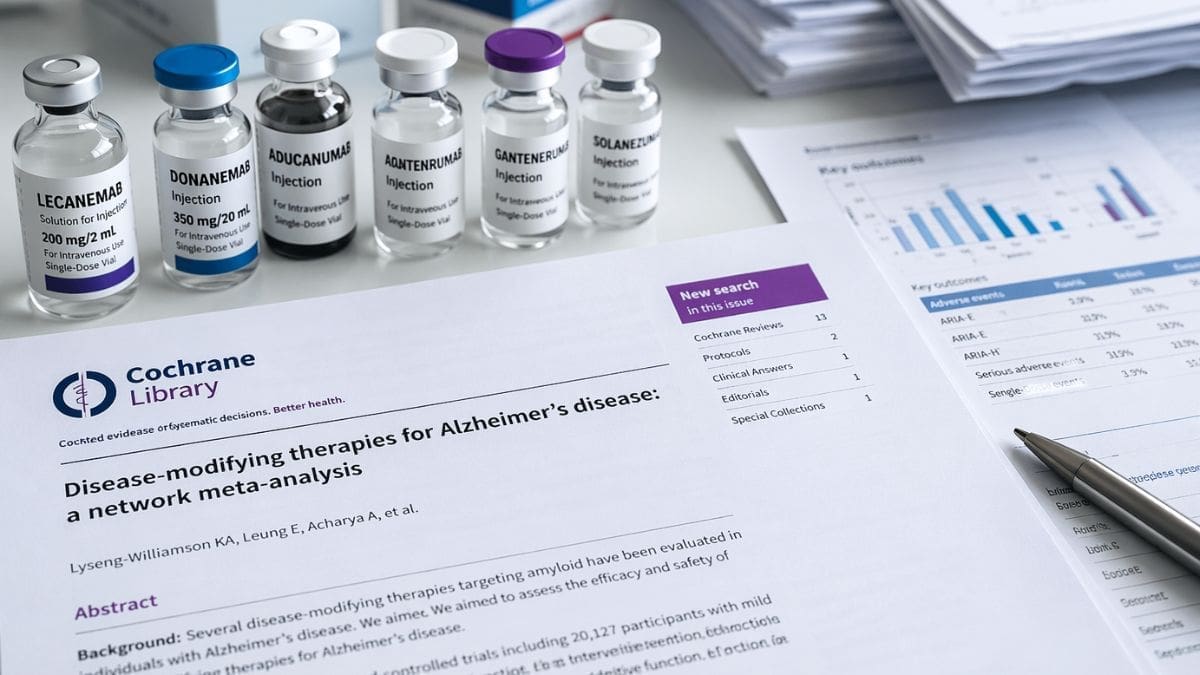
There was pushback from other researchers saying this was unfair, and they have a point. Five of those seven drugs failed their trials years ago and were discontinued. Averaging their results together with lecanemab and donanemab, the two newer drugs that did show positive effects, is a bit like reviewing every cancer drug ever tried, including the ones abandoned in the 1970s that made people sicker, and concluding chemotherapy doesn’t work. Mixing the results of drugs that failed with drugs that showed real effects produces an average that tells you very little about the drugs that are actually available.
The criticism is legitimate and it matters, because the headlines ran with the overall verdict. But the Cochrane review itself acknowledges that both lecanemab and donanemab did produce statistically significant results, meaning the effects were real. What they argue is that even those effects, in the better drugs, fall below what researchers call the “minimal clinically important difference.” That’s the threshold at which a change on a test score actually translates into something a patient or family would notice day to day.
On the main cognitive test used across the trials, the difference for lecanemab was less than one point on a 70-point scale. On the dementia severity scale, less than half a point on an 18-point scale. The reviewers are asking a blunt but fair question:
Is that enough to matter to the person living with the disease, and to the family caring for them?
That’s the real question, some researchers say yes, that even a few months of slower decline is meaningful when you’re the one living it. Others, like the Cochrane team, say the measures used in these trials may not capture what actually matters to families, and that we need better ways of measuring real-world impact.
I suppose it depends where you’re coming from. I don’t think that can be put down to one side being right and the other wrong. It’s a genuine debate about what “working” actually means for a disease like Alzheimer’s and what it really means for families.
The one thing that is true with the current drugs is the risk side of the picture. For every 1,000 people taking these drugs, around 119 developed brain swelling compared to just 12 in the placebo group. That’s a significant increase. Most cases were picked up on routine scans and caused no symptoms. But some did, and monitoring requires repeated MRI scans, frequent hospital visits, and intravenous infusions every two to four weeks. Even if you could access these drugs privately, and the cost is prohibitive for most families, the burden of treatment is significant.
NICE has looked at that balance, modest benefit against real risks and high cost, and concluded the drugs don’t currently offer good enough value to justify NHS funding. That decision is genuinely difficult and reasonable people disagree with it. But it isn’t the same as saying the drugs don’t work at all.
So where does that leave you?
These drugs are real. They slow decline, modestly, and not for everyone. They are not available on the NHS. The question of whether the benefit is meaningful enough to justify the risks and the cost is one that researchers, regulators, and families are still working through, and the answer may look different depending on whether you’re making policy for a whole population or sitting at a kitchen table watching someone you love change.
What is worth noting is the broader picture. Over a hundred experimental treatments are in clinical trials right now, targeting a much wider range of biological mechanisms than just amyloid. Researchers who have spent their careers in this field are saying with more conviction than before that combination treatments for Alzheimer’s, tackling Alzheimer’s from multiple directions, in the way we now treat cancer or HIV, are looking increasingly possible.
None of that helps the person you’re caring for today. But it’s a more accurate picture than the one the headlines painted this week, in either direction.
If you want to find out whether any current trials might be relevant, your GP or memory clinic can advise, or you can search at Be Part of Research.
Read the full Cochrane review here: Cochrane Library Read the researcher responses here: UK DRI |Alzheimer’s Research UK
In Other News
Baristas Get More Dementia Training Than Care Home Staff. Yes, Really.
A new report commissioned by Alzheimer’s Society and led by researchers at Leeds Beckett University has found that half of all dementia training packages offered to social care staff contain just one to two hours of dementia-specific content. For context, a barista training course can involve more hours than that.
Around 70% of care home residents in the UK are living with dementia. Yet only 55% of care staff in England said they had received any dementia-specific training at all. Over a third do not have even basic knowledge of the condition. Only 47% received any dementia training as part of their induction, meaning more than half of staff are starting work with people living with dementia having never been taught anything about it. And 81% of care workers said they would like more.
Dementia affects memory, communication, and behaviour in ways that require specific skills and understanding. Without that, care becomes inconsistent and often inadequate, simply through lack of knowledge. As one social care worker involved in the report put it, people living with dementia and their caregivers regularly come into contact with professionals who have limited understanding of the condition, even when they work in the field. That affects the quality of care, whether care can be sustained, and ultimately increases costs when things break down.
Alzheimer’s Society is calling on the government to include mandatory dementia training for relevant social care staff in a national dementia plan. Currently, there is no legal requirement for it. Read more here: Alzheimer’s Society
Read more here → About Khadra Awomer’s dementia caregiver journey