
Memory Matters Weekly #25 looks at three different directions in dementia research: assistive technology in real life, earlier detection through simple testing, and how long-term health conditions may shape risk.
Published 22 March 2026 -Issue #25
3 Quick Bites: Last Week in Dementia News
AI smart glasses win £1 million prize for dementia technology
Source: The Guardian, March 18 • Read it here
The story
A pair of smart glasses with a built-in AI companion has won the £1 million Longitude Prize on Dementia, awarded by Alzheimer’s Society and Innovate UK. The technology, developed by a London-based social enterprise called CrossSense, works by looking at the world through the wearer’s eyes and offering gentle prompts to help them complete everyday tasks, making a cup of tea, getting dressed, managing household routines.
The AI companion, called Wispy, learns how each individual person does things and adapts as their dementia progresses. Rather than taking over, using a microphone and a camera in the glasses, it asks questions and offers reminders so the person can still make their own choices. The team developed it alongside people living with dementia and their families, and early testing showed some improvements in object naming and short-term memory tasks. If you click here (Guardian newspaper), you can watch a short video of it in action.
The prize has been running for three years. CrossSense say they hope to make the glasses available to the public within the next year.
Why it matters
One of the hardest parts of early-stage dementia, for the person living with it and for the people around them, is watching independence quietly erode. The anxiety around leaving someone alone, the small disasters in the kitchen, the repeated questions about what comes next. Tools that can gently fill some of those gaps without removing a person’s sense of independence matter enormously.
This is not a cure and it is not going to work for everyone. But the idea that someone could be guided through or reminded of the next step when they get lost in the middle of a familiar task, is the kind of practical support that could meaningfully extend someone’s ability to manage at home.
My take
Rather than replacing what a person can do, the AI glasses tries to shore it up, asking questions, offering prompts, following the person’s own way of doing things rather than imposing a standard routine. The limitation worth noting is that this is still early. The testing involved small numbers and the glasses are not yet widely available. Real-world use across a more diverse range of people and living situations will tell us a lot more about how well it actually works day to day. But as a direction of travel, this is an encouraging one.
A Nasal Swab Could Detect Alzheimer’s Earlier Than Ever
Source: Futurity, 20 March 2026 • Read it here
Story
Researchers have developed a nasal swab test that may detect early signs of Alzheimer’s disease before symptoms appear. The test looks at biological markers linked to inflammation and degeneration in the brain, collected from the nasal cavity. Because the nose is closely connected to the brain, it provides a potential window into early changes.
In the study, the test was able to identify differences between people with Alzheimer’s and those without, suggesting it could be used as a non-invasive early screening tool.
Why it matters
Most dementia diagnoses happen after symptoms are already affecting daily life. Earlier detection matters because the treatments that exist now, and the ones coming through in trials, are thought to work best when started early. If a test could identify Alzheimer’s before symptoms take hold, it could open a window for intervention that currently does not exist for most people. But early detection also raises its own questions, especially when there is still no cure.
My take
Early testing always sounds like progress, and in many ways it is. But I keep coming back to what happens next. If someone is told years earlier that they may develop Alzheimer’s, what support actually follows that information? Without that part, early diagnosis risks becoming information without direction. And that can be hard to deal with. Limitations were that this was a very small study.
Type 1 Diabetes Linked to Higher Dementia Risk
Source: Psychology Today, 18 March 2026 • Read it here
Story
A large American study following nearly 284,000 adults over the age of 50 has found that people with type 1 diabetes were almost three times as likely to develop dementia as people without diabetes. People with type 2 diabetes were around twice as likely. The study, tracked participants using health records and survey data over an average of two and a half years. The results were consistent regardless of gender or ethnicity.
The reasons are not fully understood, but may involve long-term blood sugar levels, vascular damage, or inflammation affecting the brain.
Why it matters
We often hear about type 2 diabetes and dementia, but type 1 is talked about far less in this context. This adds to growing evidence that long-term health conditions and brain health are more connected than we once thought.
If you are supporting someone who has both type 1 diabetes and is showing signs of cognitive change, this research gives important context. It is not a reason to panic, but it is a reason to make sure both conditions are being actively managed and monitored together rather than in separate silos.
The link between type 2 diabetes and dementia has been studied for years. What is newer here is the specific focus on type 1 diabetes and the size of the association found. Nearly three times the risk is a meaningful signal.
My take
The limitations are worth keeping in mind. The follow-up period was short and the study relied on health records, which means some diagnoses may have been missed or incorrectly classified. A Swedish study published last year found a similar but slightly smaller association over a much longer follow-up period, which adds some confidence that the finding is real.
But the researchers were clear that this does not prove diabetes causes dementia, it shows an association between the two conditions.
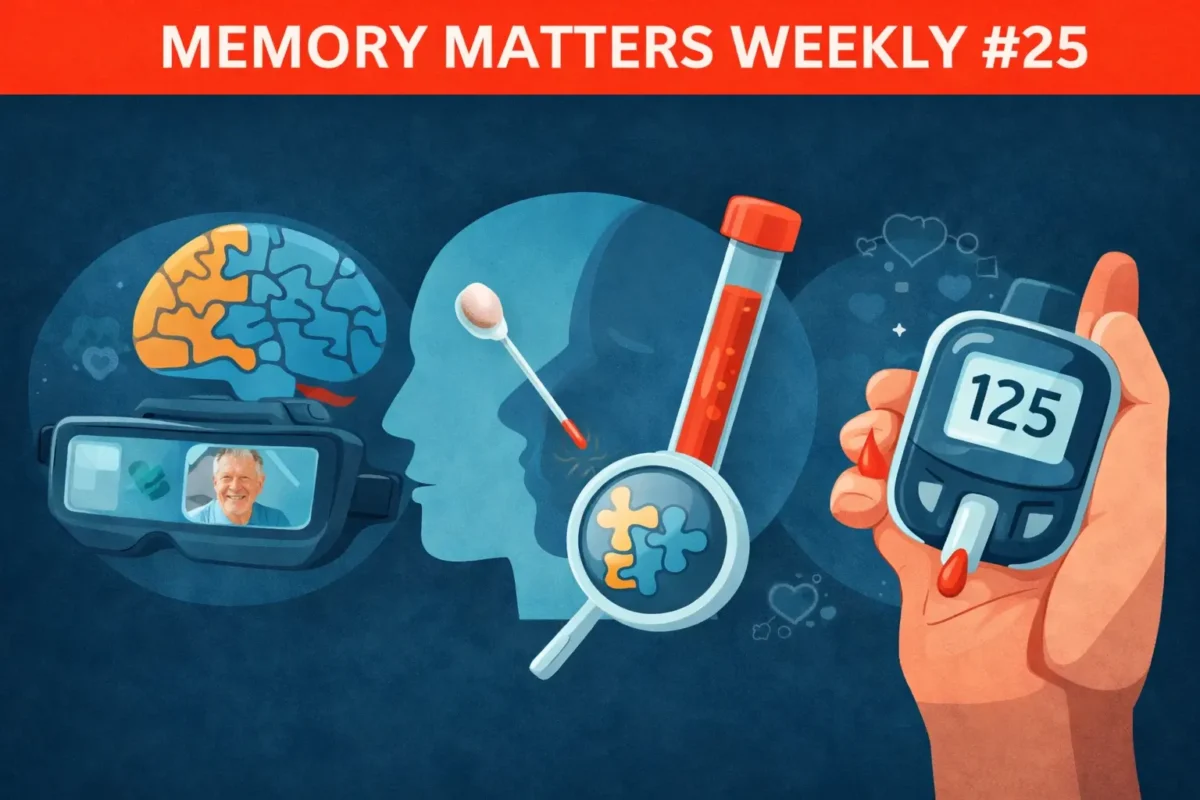
What these studies remind us
Dementia research is moving in multiple directions at once. Some of it is focused on earlier detection, some on managing risk over time, and some on supporting people already living with it in more practical ways.