

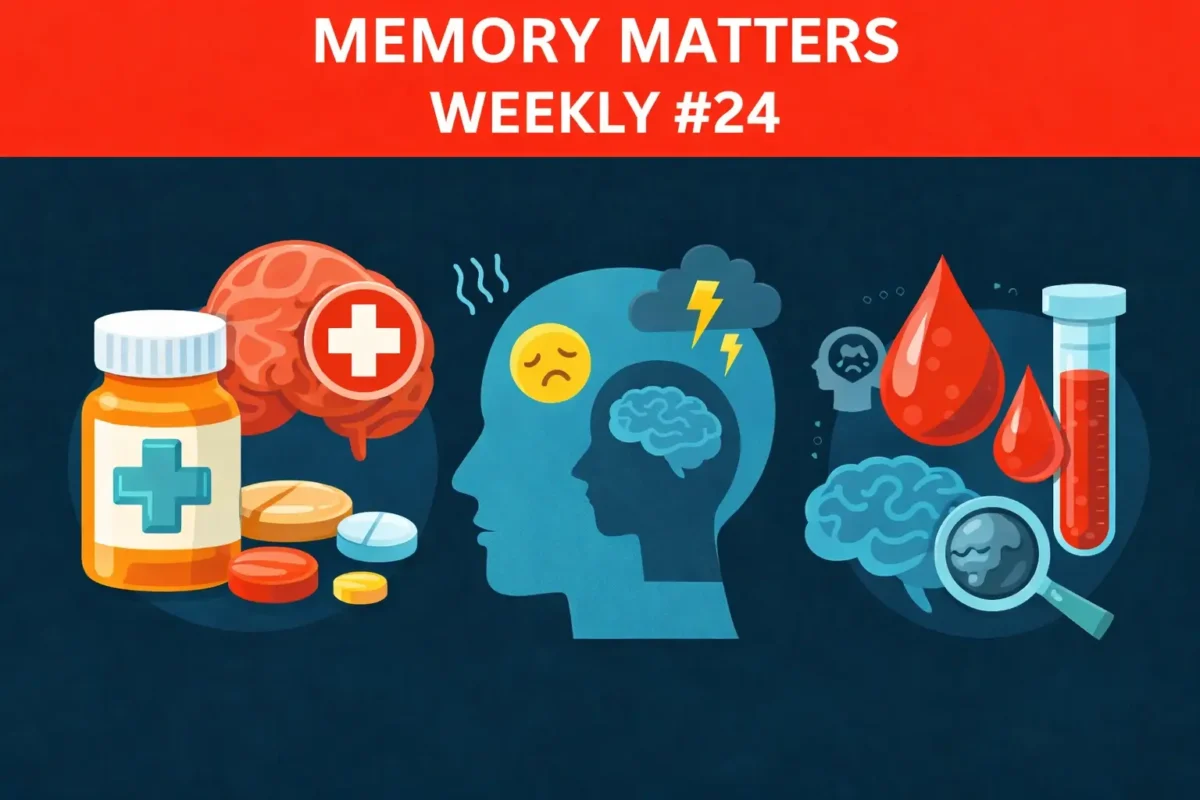
Memory Matters Weekly #24: looks at three different signals in dementia research: medication risk, early behavioural changes, and biological markers that may appear decades before symptoms.
Published 15 March 2026 -Issue #24
3 Quick Bites: Last Week in Dementia News
Medication linked to higher stroke risk in people with dementia
ScienceDaily • 8 March 2026 • Read it here
Story
A large population study analysing health data from more than 165,000 people with dementia has found that a commonly prescribed medication may be associated with a higher risk of stroke. Researchers compared dementia patients who were taking the drug with those who were not and found stroke rates were higher among those using the medication.
The medication in question is risperidone, an antipsychotic sometimes used to treat severe agitation or aggression in dementia. It is the only antipsychotic licensed in the UK for short-term treatment of persistent aggression in Alzheimer’s disease, and NHS guidance recommends limiting its use to around six weeks.
In practice, many patients remain on it for longer, and monitoring varies widely across the country.
Why it matters
The researchers say the findings highlight the need to weigh potential benefits and risks carefully when prescribing medication to people living with dementia, particularly when other health conditions are involved.
This matters for conversations you have with doctors. If risperidone has been prescribed, or is being considered, this research gives you a firmer basis to ask: How long will this be reviewed? What monitoring is in place? Are alternatives being explored?
My take
Risperidone’s stroke risk has been known for years. What this study challenges is the idea that clinicians might be able to identify a “safer” subgroup of patients who could take it without that risk. The findings suggest that assumption may not hold.
If that holds up in further research, it could push for clearer and more person-centred prescribing guidance. That would be a meaningful step forward for families navigating these decisions. The limitations are this study does not prove that the medication directly causes strokes. Instead it shows an association in real world patient data.
Behaviour changes may appear before memory loss in early dementia
Karolinska Institutet • 9 March 2026 • Read it here
Story
Researchers at the Karolinska Institutet report that behavioural changes may appear before memory problems in some people who later develop dementia. Their study suggests that shifts in personality, mood, or behaviour may reflect early biological changes happening in the brain years before diagnosis.
These changes can include irritability, apathy, or changes in emotional control. Scientists believe these symptoms may relate to early changes in brain regions involved in motivation and behaviour rather than memory itself.
The findings support a growing view in dementia research that memory loss is not always the first visible sign.
Why it matters
This could be particularly useful for caregivers, because shifts in personality or mood are often one of the first things families notice and one of the hardest things to get taken seriously.
Partners and adult children frequently describe a long period of being told “it’s just stress” or “that’s just getting older” before anyone looks deeper.
This research strengthens the case that changes in behaviour and mood are not separate from dementia. They may actually be part of the same early biological process. If those patterns can be recognised earlier, and if some of the linked health conditions are treatable, there may be genuine opportunities to intervene before significant cognitive decline sets in.
My take
Studies like this help validate what many families experience long before dementia is formally recognised.
But there are limitations. The study population came from people referred to memory clinics, meaning participants were already presenting with concerns. That means the findings may not fully reflect what happens across the wider population.
The same study, two very different headlines: predicting dementia decades before symptoms
UC San Diego • March 2026 • Read it here
Story
Researchers followed nearly 2,800 women for up to 25 years, measuring a protein in their blood called p-tau217, which is linked to the kind of brain changes seen in Alzheimer’s disease.
Women who had higher levels of this protein at the start of the study were significantly more likely to develop dementia or memory problems later, sometimes decades later.
The same study also examined whether hormone therapy affected that pattern. It found that women taking an older combined form of HRT (oestrogen plus progestin) who also had higher levels of the protein showed a stronger link to dementia than women taking placebo. Women on oestrogen-only HRT did not show the same pattern.
This week the study was reported two different ways. One headline focused on the blood test angle: the possibility of spotting dementia risk 25 years earlier. Another led with the menopause and hormone therapy angle.
Both headlines came from the same study. Neither is exactly wrong, but each highlights a different part of the findings.
Why it matters
Research into early detection is one of the fastest moving areas in dementia science. If reliable biological markers can be found decades before symptoms appear, it could eventually allow earlier monitoring, prevention trials, or targeted treatments.
But this story also shows how the same research can generate very different headlines depending on which finding is emphasised.
The hormone therapy result also needs context. It applied to an older oral combined HRT formulation given to women aged 65–79, long after menopause. That is very different from the patches, gels and body-identical progesterone commonly used today when HRT is started at menopause.
The underlying study is really about long-term biological signals linked to dementia risk, not about whether modern menopause treatments increase dementia risk.
Understanding that distinction matters, because headlines about dementia risk and menopause treatment can easily create unnecessary anxiety if the context is missing.
My take
Between the two interpretations, the broader biomarker finding feels more relevant.The idea that we might one day identify dementia risk this far in advance opens the door to earlier lifestyle interventions, targeted monitoring, or participation in prevention trials.
But “might one day” is doing a lot of work here. The blood samples used in this study were collected in the 1990s and analysed decades later. The test was not used in real time to predict anything. It showed, retrospectively, that the biological signal was already present.
What these studies remind us
Dementia rarely begins at the moment it is diagnosed. Long before memory problems appear there may be medication effects, subtle behavioural shifts, or biological changes happening quietly in the background.
Research like this does not give us immediate answers, but it does slowly sharpen the picture of how dementia develops and where earlier intervention might one day be possible.