

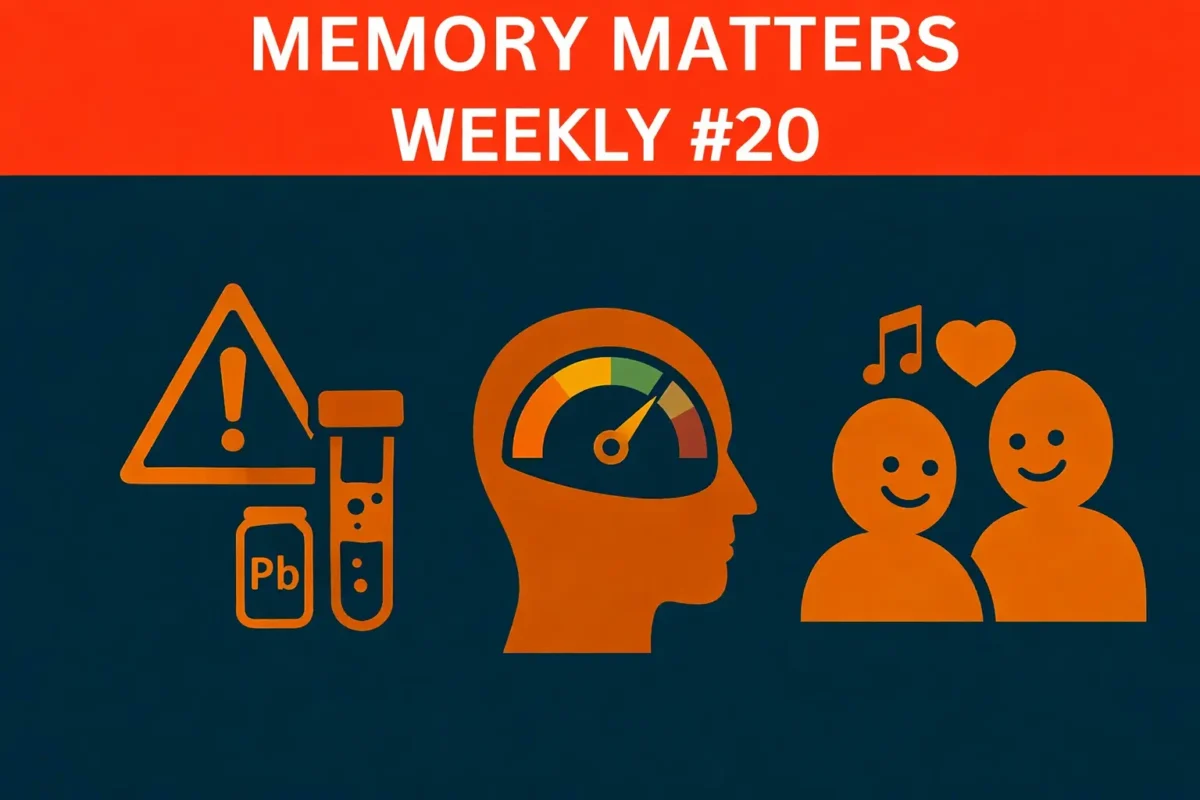
Memory Matters Weekly #20 looks at dementia from three different angles. They show how dementia risk and experience are shaped over time, through environment, behaviour, and care.
Published 15 February 2026 -Issue #20
3 Quick Bites: Last Week in Dementia News
Lead exposure linked to tripled Alzheimer’s risk
University of Michigan School of Public Health • 12 February 2026 • Read it here
Story
A new study suggests that higher lifetime exposure to lead may triple the risk of developing Alzheimer’s disease. Researchers from the University of Michigan followed thousands of older adults for up to 30 years, measuring lead that had built up in their bones over a lifetime. They wanted to know whether exposure from decades ago could still be affecting brain health today.
People with the highest bone lead levels had nearly three times the risk of developing Alzheimer’s disease and twice the risk of any type of dementia compared to those with the lowest levels.
Why it matters
It highlights how environmental factors from years earlier may influence brain health in later life. It also raises public health questions. Lead exposure has historically affected lower-income communities at higher rates, which may contribute to health inequalities in dementia outcomes.
The researchers estimate that about 18% of new dementia cases each year in the US, around 90,000 people, might be linked to lifetime lead exposure. It also reinforces why protecting future generations from lead in water, soil, and older housing still matters.
My take
This research expands the way we think about risk. It is not only about genetics or lifestyle choices in older age. It is also about environmental conditions people lived with years ago. Something as invisible as lead exposure decades ago could be contributing to what our loved ones are going through now.
The encouraging part is that lead exposure is something we can reduce, which means prevention is not out of our hands. The study shows a strong link, but it doesn’t prove lead causes Alzheimer’s on its own.
Impact of cognitive training on claims-based diagnosed dementia over 20 years: evidence from the ACTIVE study
Alzheimer’s Association Journal •9 February 2026 • Read it here
Story
Researchers followed around 2,000 older adults for 20 years from the long-running ACTIVE trial after they completed different types of cognitive training exercises to see who later received a dementia diagnosis.
Participants were split into groups: some did speed-focused exercises, such as quickly identifying objects on a screen, others practised memory strategies or reasoning puzzles, and a control group did no training.
Over the full group, none of the training types on their own clearly reduced dementia diagnosis rates. However, people in the speed-training group who also returned for booster sessions 11 and 35 months later had about a 25% lower risk of being diagnosed with dementia over the next two decades.
Why it matters
This is one of the longest follow-ups we have from a cognitive training trial, stretching across 20 years. It suggests that a specific type of structured, repeated training may help delay a dementia diagnosis.
Because this started as a randomised trial, the findings are stronger than most prevention studies, though they still aren’t final proof.
The key detail is consistency. The lower risk showed up in the group that did speed training and came back for booster sessions. Memory and reasoning training did not show the same long-term effect in this study. Speed training without boosters did not either.
My take
What stands out to me is how specific the result is. This wasn’t a general message that all brain training works. It was one particular type of adaptive, speed-based training, repeated over time.
That makes it promising, but not a quick fix. It adds to the prevention conversation in a more grounded way. It suggests that certain structured activities, done properly and revisited over time, may have a real impact. That’s different from casually doing puzzles and hoping for the best.
Person-centred care improves outcomes for people with dementia and caregivers
University of Kentucky • February 9, 2026 • Read it here
Story
A study from the University of Kentucky looked at what happens when care homes prioritise what matters to residents, things like music, art, time outside, and meaningful daily activities, instead of focusing only on medical tasks and safety.
Researchers measured residents’ quality of life and staff wellbeing when person-centred care approaches were put into practice.
Why it matters
The findings suggest that when care focuses on what makes life worth living, not just keeping people safe and fed, everyone benefits. Residents were healthier and happier, and the staff felt better about their work too.
For family caregivers, this is a reminder that the small moments of connection and joy matter just as much as the medical appointments and medications. It’s permission to prioritize a favorite song, a walk outside, or whatever brings a smile, even when there’s a long to-do list. And if you’re looking at care homes or other support services, it’s a good reminder to ask about their philosophy: do they focus on enrichment and personhood, or just on tasks?
My take
This study doesn’t lay out every detail of how the changes were delivered, so it’s best seen as direction rather than a step-by-step plan. It was carried out in professional care settings in the US, so it may not translate perfectly to home caregiving or to services where you live.
But the core message holds. People living with dementia are still people with preferences, personality, and history. Care that reflects that seems to benefit everyone involved.
What I appreciate is that this approach also supported staff wellbeing. That matters. Supporting the caregiver, whether professional or family, isn’t separate from supporting the person with dementia.
And I know this can feel idealistic on hard days. When someone is agitated or you are running on empty, enrichment can feel like one more thing to manage. This isn’t about adding pressure. It’s about recognising that small moments of connection count, even if they are brief.
What Connects These Stories
All three studies look at dementia from a different angle. One examines long-term environmental exposure. One looks at structured cognitive training over decades. One focuses on how care is delivered day to day.
It highlights how dementia risk and experience are shaped over time. Years before symptoms appear. Years after diagnosis through environment, behaviour, and care culture.
These stories reinforce something important. Dementia is not shaped by one moment or one decision. It is influenced across a lifetime, and how we respond after diagnosis still matters just as much.