
The documentary Chris Hemsworth: A Road to Remember follows Chris as he sets out on a deeply personal road trip with his father, Craig, who is living with Alzheimer’s. The journey began because Chris had started noticing subtle changes over the past two years.
Some days his dad was clear and present. Other days he saw signs of memory loss.
That uncertainty led Chris to explore what might still help, and whether memory could be strengthened through connection.
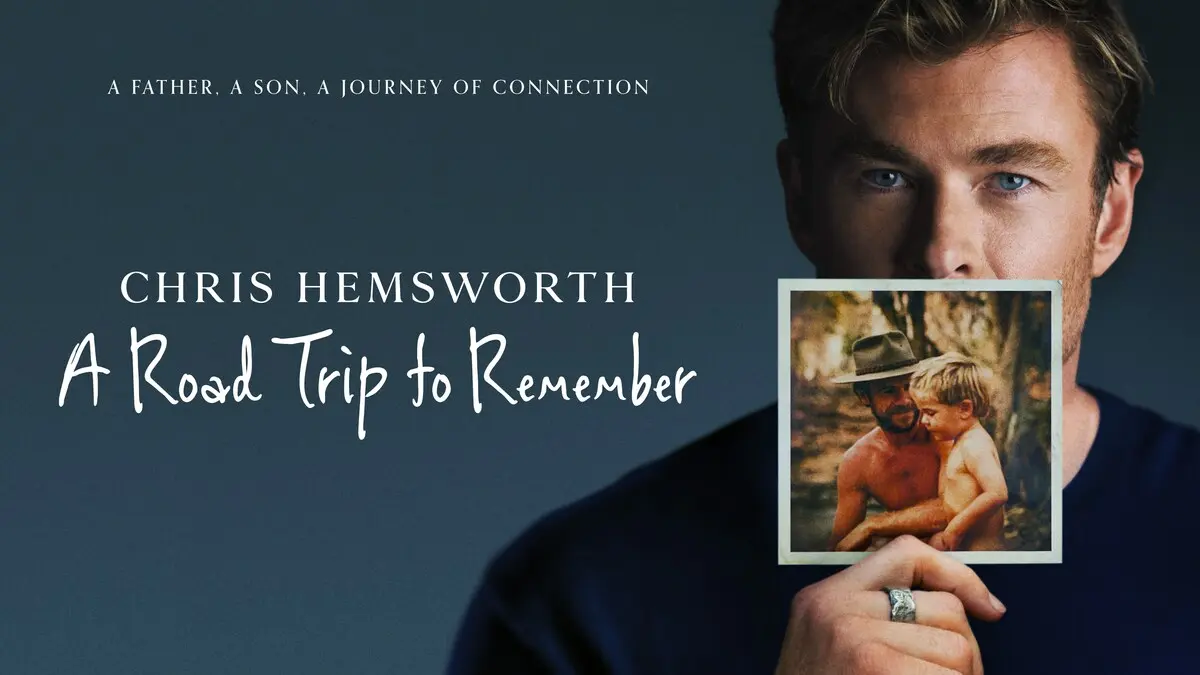
Image Credit: National Geographic/Disney
He turned to specialists who explained that retrieving old memories could work like training a muscle. Dr Siraj Sattan, clinical psychologist, describes it simply:
“If you want to build your body, you lift weights. For our brain, we can do the same thing by practising retrieving memories from the past.”
That idea shaped the entire journey. To exercise his dad’s memory in order to strengthen it.
After meeting Dr Sattan at the football game and hearing the science of connection, the family road trip grew into something far more intentional, an immersive experiment in supercharged reminiscence therapy.
So Chris takes his father back to the places, people, and memories that formed their family. We hear the quiet honesty of his mother, Leonie. We see how Chris wrestles with asking the difficult questions. And we hear from Craig himself, speaking not just as someone with a diagnosis, but as a person still navigating his own emotions.
Why Reminiscence Matters
The film introduces the science behind reminiscence therapy. When Chris and his dad returned to their former Melbourne home, it wasn’t just to walk through it. The production team rebuilt it almost exactly as it looked in the 1990s. The result was immediate.
Memories came flooding in for all the family.
Craig didn’t just recall facts. His expressions changed. His sentences lengthened. He laughed more. He recognised objects that had been gone for decades. It becomes clear that reminiscence therapy is not just memory.
Seeing, touching and hearing our past can make it easier to remember. It also triggers associated events and details, reactivating dormant memory networks. This is reminiscence therapy made fully immersive, a multi-sensory workout for the brain.
Supercharging Reminiscence With Social Connection
The science deepens when Chris talks with Dr Sattan about social connection. He explains that active connection can reduce dementia risk by half. He calls it “sunshine for the brain.” He says,
“Social connection is like sunshine. Without that sunshine, we wither.”
The documentary shows this clearly by using community, friendship and shared history as therapeutic tools. Craig reunites with old friends in town called Bullman.
His mood lifts. His voice strengthens. He remembers names and cracks jokes. He recognises people he hasn’t seen in 35 years and talks openly about work, danger and laughter.
This is what the film refers to as social bridging. Not just speaking with close family but reconnecting with less familiar faces, which forces the brain to reach for older and more distant memories. That is why Craig becomes more expressive in Bulman. Connection becomes cognitive work.
The Emotional Core
In a quiet moment at their old family home, Chris mentions how many times his dad asked where Leonie, his wife, was. Leonie admits that returning there was overwhelming, “a flood of memories,” as she describes it.
She shares her fears honestly.
The hardest part, she says, is wanting the relationship they always had. She admits that sometimes she wakes in the night and feels terrified thinking about where it is all going.
Through her voice, the documentary shows that Alzheimer’s doesn’t just change the person living with it. It reshapes every relationship around them.
As the trip goes on, Chris begins to ask the questions that every caregiver eventually faces. What is my loved one feeling? Are they aware of what is changing? Are they afraid?
He tells the camera how difficult it is, how often we delay these conversations for our own comfort. But he says this was always his goal on the trip: “to talk to Dad about how he’s feeling… and does he have fears?”
He briefly mentions his own genetic risk of Alzheimer’s, but sets it aside. “I’m far more focused on my dad right now.”
How Craig Feels
The turning point comes when Chris finally asks how his dad feels about the illness. Not how he is, but how he feels. Craig pauses, then answers with clarity. Not about forgetting, and not about symptoms. But about dependence.
He says he fears being a burden.
What the Documentary Leaves Us With
This is not a story about loss. It is about protecting connection while decline is happening. It shows that memory does not always disappear and that reminiscence can still reach a person in ways that medication sometimes cannot.
It does not romanticise dementia or sugar-coat it. It simply offers this truth. Memory may fade, but connection still knows where to find us.
Therapy does not always look clinical. Sometimes it looks like time together. The past is not always gone. Sometimes it just needs a way back in.
By the end of the trip, Chris says he cannot know if reminiscence therapy will have a long-term effect, but he did see something change.
“I definitely noticed that he became more engaging and outspoken, more comfortable. So hopefully it continues on but right now I feel so thankful for how I saw something awaken within him.”
Finally
A Road to Remember is not a film about decline. It is about how community and social connection can act as medicine.
It shows that memory is not only kept in the mind. It can live in places, smells, friendships and familiar moments. The takeaway is something we can all try.
We can help our loved ones stay mentally, physically and socially active, and use the power of reminiscence to rekindle memories.
By the end of the journey, Chris realises something quietly. He just wants to spend more time with his dad and appreciate every moment. To simply be present.
This Road to Remember documentary is a grounded and powerful watch for anyone who has ever loved someone living with dementia. It shows that when we create room for memory, even fading memory, a person can sometimes step back into the light.
Catch the documentary on the National Geographic channel and streaming on Disney+