
There’s something deeply satisfying about tearing through old newspapers and magazines, sorting colourful images into piles, and arranging them into something arty.
I discovered magazine collage by accident when Mum was having a particularly restless afternoon and kept tearing up tissues. We’d done the usual things and nothing was working, so I decided to just lean into it. I got out a stack of old magazines, started tearing out pages, and Mum followed suit. That’s how we started doing magazine art collage.
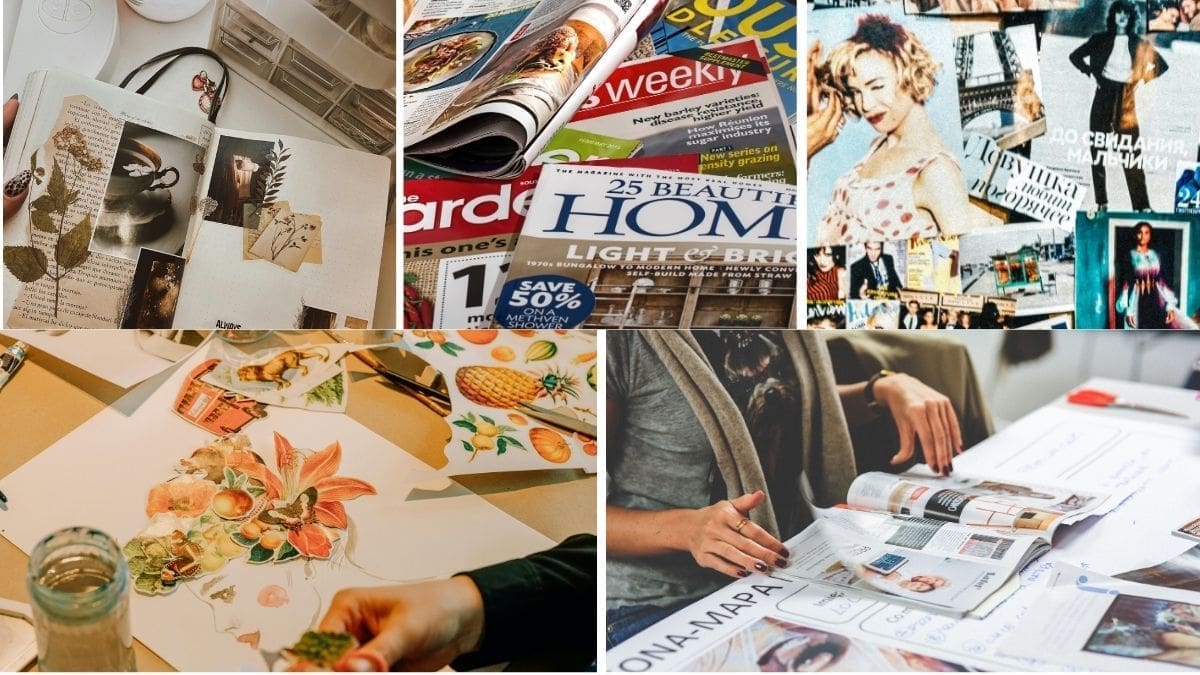
That afternoon taught me something important: the activities that work best in dementia care aren’t always the obvious ones. Art continued to surprise me, and how well Mum took to it surprised me most of all.
Related: How Art Can Help Those With Dementia
Why Magazine Collage Actually Works
Tearing paper isn’t the same as threading a needle or holding a paintbrush steady. I watched Mum work alongside me, her hands warm and busy. That rhythm of tearing, sorting, arranging, tearing again. It just worked. She wasn’t watching television or sitting idle. She was doing something with purpose, and it was very calming.
Colours and images triggered memories. I’d show Mum a picture of a garden from a glossy magazine, and she’d start talking about her own garden, or the tomatoes she used to grow. It keeps fidgety hands occupied and it starts conversations. Win, win.
There’s also the fact that it costs practically nothing. When money’s tight and you’re already paying for care, medication, and everything else, it matters that you can do something creative with things you’d otherwise throw away.
Getting Started: What You’ll Actually Need
Old magazines and newspapers are the main thing you need. The glossy ones are best because they have colour and variety. Lifestyle magazines, travel magazines, anything with photographs of food, places, plants, or people works brilliantly. I kept a pile of free magazines that arrived unsolicited through the post and old copies of Sunday supplements.
- You could use scissors, but honestly, you don’t even need those. Tearing works just fine. In fact, I often didn’t bother with scissors because tearing was what Mum preferred anyway.
- You need glue. A glue stick is cleaner and less messy than liquid glue. Keep it in a little box so it doesn’t keep rolling off the table.
- You need a base for your collage. Pieces of card work best, but if you don’t have any, a few sheets of A4 paper stuck together work well, or glue your paper onto cardboard for extra stability.
That’s all you really need.
5 Simple Magazine Collage Projects
Here are five simple newspaper and magazine collage projects that work beautifully
Magazine Memory Garden
Spend an afternoon flipping through old gardening magazines and supplements, tearing out anything featuring flowers, plants, trees, or garden scenes. You’ll end up with a pile of images ranging from rose gardens to vegetable patches to wild meadows.
Start arranging them on a large piece of cardstock. Place the bigger images first to create anchor points, then fill the gaps with smaller images, layering them loosely so you can see the edges or do whatever works for you best. Mum helped me decide where things should go, though by the end she was mostly pointing whilst tearing more pieces.
The finished piece might look like a chaotic abundance of colour but it works.
The Favourite Foods Collage
I did this one when Mum was having difficulty talking about what she wanted to eat. Mealtimes had become a bit fraught because she’d forget what she liked, or she’d want something without being able to explain what that something was. I thought: what if I made a visual menu?
I gathered food magazines, recipe books, and anything with pictures of food. I looked for things that seemed to matter to mum, her favourite things: fresh fruit, cakes, bread recipes, cups of tea, indian rice dishes etc. We tore them out and created a collage on a large piece of cardboard. I placed it in the kitchen and brought it out when mum wasn’t feeling motivated by food.
Showing pictures of other peoples recipes or even printing off pages of food photos you’ve taken also work as a food art collage.
It worked differently than I expected. I thought we’d made a functional thing, but what we’d actually made was images that represented things that mattered to her, things she’d enjoyed, and foods she loved.
Colour Sorting Sensory Collage
This one is probably the simplest. Rather than choosing a theme, just go with colours. Tear off a lot of pieces from glossy magazines and sort them together into colour families: reds and pinks, oranges and yellows, greens, blues, purples.
Then create sections on a large piece of card, filling each section with pieces of the same colour family, or mix them together into something abstract like a rainbow.
The sorting part takes a little longer, and your loved one may not be interested in that stage, so you could break the activity up. But if they enjoy structure and categorisation, the sorting itself can be meditative. The end result will look completely different from anything else you’ve made together.
This Is Me: Life Story Collage
This one is particularly good for the later stages of dementia, when visual reminders of who someone is can matter enormously. Make a collage together of images that reflect their life and interests.
Think about the things they’ve loved: travelling, gardening, reading, grandchildren, cooking, painting. Look through magazines together for images that represent these things. Look for images of different careers or jobs, it’s great for conversation too. You can add words or phrases cut from magazines: “Scholar,” “Dog Lover,” “Artist,” their name, or other meaningful words.
Make it on a large piece of poster board and frame it, then this becomes something the whole family can enjoy and add to.
Seasonal Celebration Collage
This is probably the easiest of all in terms of finding the right images. Choose a season and gather images that represent it: autumn leaves, winter frost, spring flowers, summer sunshine. It’s a lovely way to anchor someone in the time of year.
For winter, look for evergreens, cosy interiors, hot drinks, cool greys and blues and silvers. For autumn, warm colours, leaves, pumpkins. For spring, fresh greens and flowers coming into bloom.
You can make this a group activity too, with everyone choosing their favourite season and making their own version.
Making Life Easier
- Don’t feel like you need proper magazines from the newsagent. Junk mail, free papers, old Sunday supplements, anything glossy with images will do. Once you’ve tried making these, you’ll find yourself keeping a carrier bag of collected materials ready for the next one.
- You can also split this across a couple of days. The tearing and sorting can be one session and the arranging and gluing can be another. There’s no rush, and breaking things into smaller pieces of time makes it less overwhelming for everyone.
- Keep it messy. Paper scraps end up on the table and the floor. Hands get covered in glue. That’s fine, it’s part of the process. Just have some wet wipes handy.
- Don’t explain too much. I’d show Mum what we were doing and just get started. “We’re going to find some nice pictures and make something lovely together.” Long explanations made things feel more formal and demanding than they needed to be.
- Background music helps, and don’t forget to chat about the images and whatever they bring to mind.
- There’s no timeline. The benefit is in the doing, not in rushing to completion.
- Save your scraps. Leftover pieces can be used in another project.
I found that working alongside Mum, rather than directing her, made all the difference. I was making a collage with her. Some of them looked quite nice. Some of them looked like chaos. That wasn’t really the point.
What mattered was the time spent doing something together, watching Mum’s hands move with purpose, and the conversations that started because of a picture in a magazine. I hope you enjoy it too.

Read more here → About Khadra Awomer’s dementia caregiver journey