
Our long-term memory holds the places that mattered most to us, childhood holidays, a honeymoon destination, the town someone grew up in. These memories are often still there with loved ones living with dementia, held more deeply than people expect.
A travel memory map gives us a way to connect to those preserved memory. For caregivers, it is a gift too, a ready-made conversation starters, just point to a place and ask what it was like. Then listen.
What is a Travel Memory Map?
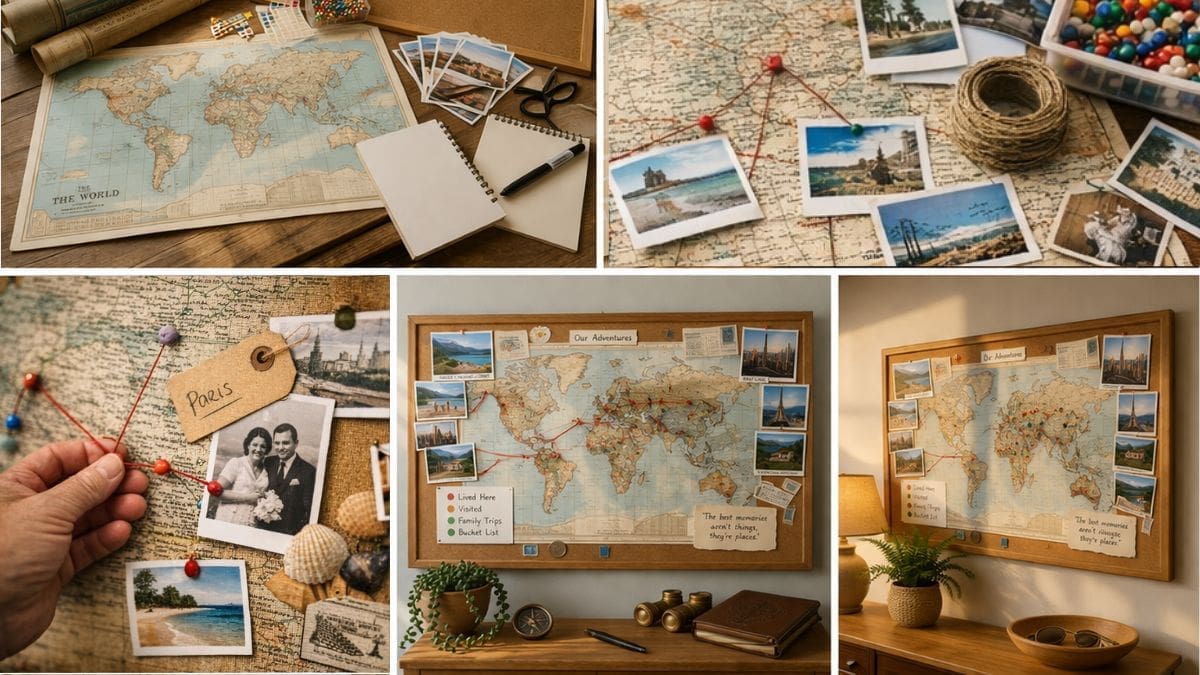
A travel memory map is exactly what it sounds like, a large, visual, personalised map that marks the places a person has lived, visited, loved, or simply always wanted to go. It is part artwork, part scrapbook, part conversation starter.
Some are simple, a printed map and a few coloured pins. Some are more elaborate, with photographs tucked around the edges, postcards and handwritten notes, a ribbon of string connecting a pin to a picture of the people who were there.
It’s a great way to build up stories of the past. Where they grew up. Where they honeymooned. Where the family went every summer for fifteen years running. It’s a way to keep an active reminder of all those good times on a wall or on a table.
So it’s just a large map, mounted somewhere that can be seen every day, marked with the places that meant something in a person’s life.
What You Will Need
The basics are simple and the cost is low:
- A large map, the bigger the better. An A1 or A0 print works well. A vintage or antique-style map adds warmth and tends to be more visually appealing than a modern road atlas page. Ordnance Survey maps work beautifully for UK places. A world map if the person has travelled widely.
- A large backing board, corkboard, or a simple frame, something the map can be mounted on sturdily enough to be handled.
- Coloured pins, stickers, or small flag markers to mark places.
- Photographs,printed small, or full size if space allows.
- Anything that can be attached or displayed nearby: postcards, luggage labels, ticket stubs, foreign coins, a pressed flower, a pebble from a beach.
- Handwritten notes or labels, in a large, clear font if writing them out, or printed if handwriting is difficult.
- Optional: washi tape, ribbon, string connecting pins to photographs pinned around the border, watercolour washes over certain regions, decorative stickers.
That is genuinely all that is needed to start.
How to Make It – Step by Step
Step one: Gather the stories before gathering the materials.
Before buying anything, sit down with the person, or with family members if the person is no longer able to contribute directly,and make a list of places. Whatever comes up.
Where did they grow up? Where did they go to school? Where did they meet their partner? Where did they honeymoon? Where did the family go on holiday when the children were small? Was there a place they always talked about wanting to visit? A city they lived in for a few years? A relative’s house they visited every summer?
Write it all down. Every place, however small. A village. A street. A particular beach. They’ll become the pins on the map.
Step two: Choose the right map for the right life.
Match the map to life. Someone who never left the British Isles does not need a world map that will feel overwhelming or impersonal. A detailed map of the UK will have far more meaning and far more to find on it. Someone who worked abroad, or emigrated and returned, or went on cruises to far-flung places, might need something larger.
Vintage and antique-style maps, available as inexpensive prints online, tend to work better than modern ones. They feel warmer. They look more like something that belongs in a life rather than on a sat-nav screen. Ordnance Survey vintage reprints are particularly good for UK places because they show the landscape, the coastline, the character of a region, not just the roads.
Step 3: Mount it somewhere sturdy and accessible.
A corkboard is ideal because pins go straight in without fuss. The map needs to be large enough that place names are readable without squinting, and robust enough that it can be touched and pointed at without buckling. If it is going on a wall, make sure it is at a height where someone seated can see it comfortably.
Step 4: Add the pins, and label them.
Start with the places from the list. Use different coloured pins if that helps, one colour for places lived, one for places visited, one for places that hold a particularly strong memory. Or keep it simple and use one colour throughout.
Write a small label for each pin if possible. Not a detailed note, just a word or two. “Born here.” “Honeymoon, 1959.” “Family holidays.” “Lived here after the war.” These prompts mean the map can be used independently, without a carer present to explain what each pin represents.
Step 5: Add the personal touches.
This is where a travel memory map becomes something more than a map. Attach small photographs around the edges, a picture of the family on a beach holiday, a wedding photograph taken in a particular town, a snapshot from a trip abroad. Connect them to their pins with a length of ribbon or string if space allows.
Tuck in any nostalgic items that have survived, a postcard from a place, a foreign stamp, a small souvenir. These tactile objects matter, holding a coin from a country visited decades ago is a different experience to simply seeing a pin on a map.
Add decorative touches if that feels right, watercolour washes over regions of particular significance, hand-lettered place names, pressed flowers from a garden that was loved. Or keep it clean and uncluttered. Follow the person’s taste, not a template.
Step 6: Put it somewhere it will actually be seen.
Put it on a wall in the room where the person spends most of their time. Not in a folder. Not brought out occasionally as a special activity. It should be part of the room, something the eye drifts to, something a visitor notices and asks about it. A grandchild points to a place and a story comes out that nobody in the family had heard before. That can only happen if the map is there to be seen!
Tips Worth Knowing
- Make it with them rather than for them wherever possible. Even a small contribution, pointing to a photograph, naming one place, choosing a pin colour, means the map belongs to them in a way that something made entirely without them does not.
- Do not worry about gaps or getting it wrong. A map with six pins and three photographs is not a lesser version of the idea. It is already rich. Add to it as more memories come up over time, because they will.
- Use it as an activity on difficult afternoons, not just as wall decoration. Bring it to the table. Trace a route with a finger. Ask what the weather was like in that place. Ask who they went with. Ask what they ate. That map is way in to start conversations and have a great afternoon chatting over a cup of tea.
- Let other people use it too. When family visits, when a carer is new and does not yet know the person’s history, the map gives everyone an immediate way into who this person is and was. “Tell me about this place” is a question anyone can ask, and the answer tends to do more for connection than any amount of small talk.
- If the person never travelled far, reframe it entirely. A map of a home town, marking the school, the church, the street they grew up on, the factory or shop where they worked, the park where they walked the dog for thirty years, is every bit as valid. A life lived in one place is not a life that lacks material. It just needs a different scale of map.
- Photographs do not have to be old. A recent photograph of a place, printed from Google Street View if no other image exists, can still act as a starting point, just pointing out what’s changed. The visual cue is what matters, not the vintage of the image.
- If a new memory surfaces then update it. If a place is suddenly mentioned that was not on the original list, add it. A living map is more powerful than a finished one.
- Consider making a smaller laminated version as well. An A3 copy that can sit on a table, be held, be taken to a care home visit. The wall version is the display. The portable version is the activity.
What A Travel Memory Gives
What a travel memory map gives a person a visible record of a life that was full and specific and theirs. It gives caregivers a way into conversation into someone’s past, and we all loved to share stories. It gives families something to gather around. It gives visitors something to ask about.
That’s why it is worth making one.