
Easter activities for seniors that aren’t crafts can be hard to find, especially when so many ideas focus on painting, cutting, or decorating.
Not everyone enjoys crafts, and for some people, they can feel frustrating rather than relaxing. Whether you’re supporting someone living with dementia or just looking for something different this Easter, there are plenty of ways to celebrate that don’t involve glue, glitter, or fine motor skills.
Whether you’re a senior looking for Easter activities that suit your interests, or a caregiver searching for alternatives to the usual craft projects, these ideas work beautifully for people at various stages of dementia and with different abilities. Some are social and lively, others are quiet and reflective. All of them capture the spirit of Easter in their own way.
Let’s explore seven ways to celebrate Easter that prove you don’t need to make anything to make memories.
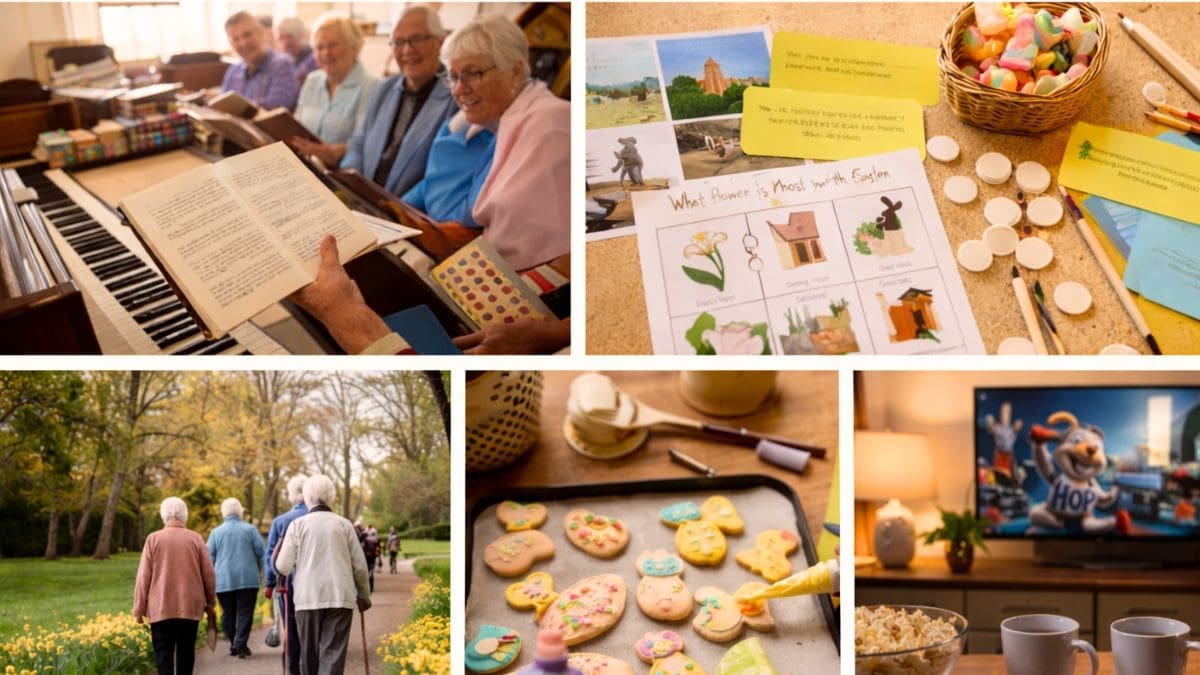
1. Easter Hymn Sing-Along: Music That Moves the Soul
There’s something powerful about singing familiar hymns together, especially at Easter. The melodies are deeply embedded in memory, often outlasting other recollections. Even people in advanced stages of dementia who struggle with conversation can often sing every word of hymns they learned decades ago.
Music accesses parts of the brain that remain intact longer than those governing language or recent memory. Easter hymns like “Christ the Lord Is Risen Today,” “Were You There,” “In the Garden,” or “The Old Rugged Cross” carry decades of associations of regular church attendance, Easter Sunday’s and family traditions.
We saw that in our Alzheimer’s society weekly singing group filled with people with different stages of dementia and sometimes some of them took the mic and were encouraged to sing solo and a lot picked familiar hymns, where they didnt need to look down at a lyric book to belt out a classic. It was quite wonderful.
Try
Gather friends and family together in a comfortable space or join a local singing group, having refreshments like a cup of tea (and biccies) will make everyone feel welcome!. Print out hymn lyrics in large font so everyone can follow along, though many will know the words by heart. If someone plays piano or guitar, live music is wonderful, but recorded accompaniment works beautifully too. YouTube has excellent instrumental versions of virtually every hymn.
Start with the most familiar hymns—the ones everyone learned as children. Sing slowly enough that voices can stay together. Between songs, invite people to share memories: “Did you sing this in church growing up?” “What was Easter like when you were young?”
The singing session doesn’t need to be long, try a few hymns with time for chat and reminiscence between them.
Adaptations
For those who can’t or prefer not to sing, simply listening works beautifully. Hand out simple percussion instruments, maracas, bells, so non-singers can participate rhythmically. I still have mum’s tambourine that she accidentally took home when we left the singing group once.
If it’s just you and your loved one, even one person and one caregiver singing together is just as meaningful, we used YT a lot, not only for singing but also for watching me prance about mimicking traditional dance moves!
2. Easter Trivia and Memory Games: Celebrating What We Know
Trivia and memory games tap into long-term knowledge that often remains intact even when recent memory falters. Questions about Easter traditions, spring seasons past, childhood memories, or historical facts engage the mind without requiring physical dexterity or artistic skill.
It is not important if you get the answers right or not, I know from my own experience it’s just fun doing something together.
Prepare questions in advance, mixing easy and moderately challenging ones. Use true/false questions instead of open-ended ones if recall is difficult: “True or false: Easter is always in December. Focus on topics likely to be in long-term memory:
Easter Tradition Questions:
- What flower is most associated with Easter? (Lily)
- What day of the week is Easter always on? (Sunday)
- What meal is traditionally eaten at Easter? (amb)
- What are Easter eggs traditionally made from? (Chocolate, hard-boiled eggs)
Personal Memory Questions:
- What was your favorite Easter candy as a child?
- Did your family go to church on Easter?
- What did you wear for Easter? (New outfit, hat, gloves)
- Did you dye Easter eggs? What colors did you use?
Seasonal Questions:
- What season is Easter in? (Spring)
- What baby animals are born in spring? (Lambs, chicks, bunnies)
- What flowers bloom in spring? (Daffodils, tulips, crocuses)
Make it conversational rather than quiz-like. When someone answers, invite elaboration: “Tell us more about that.” “Does anyone else remember that?”
You can also go the more traditional questions and answer route, play Easter riddles or do simple crosswords together.
For those with more advanced dementia, use visual prompts. Show pictures and ask simple questions or just talk about the images.
Create a memory bingo with Easter-related squares. Instead of numbers, squares contain images or words: “church,” “lily,” “chocolate bunny,” “new dress.” As you discuss each topic, players mark their cards.
3. Easter Story Reading Circle: Sharing Narratives Together
Reading aloud is a gentle, engaging activity that works for mixed ability groups. Easter offers rich material—from religious stories of resurrection to secular tales about spring, renewal, and new beginnings.
Being read to is comforting and nostalgic, connecting to childhood memories of storytime. It requires no physical effort, no artistic skill, no memory recall, just listening. Stories provide structure and narrative arc, which can be exciting or soothing depending on your genre.
Easter stories often carry deep meaning, whether religious or seasonal. They touch on themes of hope, renewal, resurrection, spring awakening,powerful concepts that resonate emotionally even when cognitive abilities have declined.
And you can make it more engaging by talking about the story and asking simple questions like what did you think of that story? or does this remind you of anything?
Just choose material appropriate to your audience. For religiously oriented groups, the Easter story from the Bible (simplified versions work well), stories of Jesus’s resurrection, or Christian picture books. For secular settings, spring-themed stories, books about gardens awakening, or tales featuring Easter symbols like rabbits and eggs.
Read slowly and clearly, making eye contact periodically. Show pictures if the book is illustrated. Don’t forget to pause at natural stopping points to check for engagement or you prompt it with “shall we continue?” or “What do you think will happen next?”
And then after reading, talk about the story, what you like best, things that it reminded you or your interpretation of the stories meaning.
Different Ways to make it easier
For those who tire easily or have short attention spans, read very short pieces, like short stories or poems which are an excellent resource as well, the rhythm and melody of poems make them particularly good.
Use audio books if reading aloud is difficult. Many libraries offer audiobook services, and platforms like YouTube have recorded readings of classic Easter stories.
You can even make it inot a “story and snack” combination and serve Easter treats given natural breaks if they’re needed
4. Easter Baking Session: Creating Through Taste
If there was one thing that my mum was great at, it was baking, and even in mid stage dementia she help me make fairy cakes, all whilst sitting in her recliner chair. I brought everything to her, she eat more of the ingredients when decorating than went on the cupcakes but it was great fun.
It’s a perfect activity as baking combines sensory engagement, familiar routines, and delicious results. Hot cross buns, simnel cake, Easter bread, easter cookies, you make whatever traditional Easter bakes carry memories and meaning. And you can’t manage baking together, then make a batch of cakes or cookies and just sit and decorate together.
Many people have decades of baking experience. Muscle memory takes over, hands remember how to knead dough, crack eggs, or roll out pastry even when other memories have faded. It’s familiar territory, you just might need to help a bit.
Unlike crafts that get displayed, baked goods get eaten and enjoyed, and let’s be honest that’s the best part!
How to Do It
Choose recipes that match ability levels:
Simple Options: Pre-made cookie dough that just needs rolling and cutting with cookie cutters, boxed hot cross bun mixes, or decorating pre-baked sugar cookies with icing.
Moderate Options: Hot cross buns from scratch (though they take time), simple Easter bread, rice crispy treats shaped into eggs or nests (those bring back memories!)
Traditional Options: Simnel cake, braided Easter bread, homemade cookies from scratch.
Just set where it works for your loved one, I’ve wheeled mum into the ktichen in her wheelchair and had a foldout table to put things on that she could reach, other times we did it in the living room in her recliner, set up where it works for you.
So many ways to help things like measuring and pouring, mixing, rolling, cutting out cookies, decorating or even just in arranging on plates. Good luck with having anything left over by the end of the activity!
If you do serve what you make immediately with tea or coffee. Fresh-from-the-oven baking is one of life’s great pleasures.
5. Spring Nature Walk
Easter falls in spring, when the natural world is visibly awakening. A walk,even a short one, to observe signs of spring connects the season’s religious themes of resurrection and renewal to the observable miracle of nature coming back to life.
Being outdoors provides sensory richness: fresh air, sunshine, birdsong, the smell of earth and growing things. These stimuli are naturally engaging and mood-lifting.
Spring changes are obvious and discussion-worthy: buds on trees, early flowers blooming, birds building nests, longer daylight, warmer temperatures. There’s inherent interest in observing and commenting on these changes.
The last few days of sunshine just make everything brighter, our daffodils are out and tulips are starting to peak through. The best thing about going for a slow short walk is that it makes you feel really good (if the weather isn’t bad) and gives you both gentle exercise without it feeling like exercise!
Just choose an accessible route: flat, paved paths work best. Gardens, parks, or short walks around your neighborhood. The distance matters less than the observation. Just point out things that you notice and enjoy the time out together!
You could even bring a basket to collect things – fallen petals, interesting leaves, small twigs, seed pods can be used later for nature-based crafts or simply displayed in a bowl.
For those who can’t walk far, drive to a scenic spot and observe from the car with windows open. Parks, botanical gardens, or even just streets with flowering trees provide visual interest. You might also be able to hire wheelchairs from local charities as an option to explore. We’ve certainly done that.
Otherwise, create an indoor alternative: bring spring indoors. Set up a nature table with potted spring bulbs, put out a bird table near a window.
6. Easter Movie Afternoon
Sometimes the best activity is settling in comfortably to watch a good film together. Easter-themed movies, from classic religious epics, animated spring stories or even the best natural life episodes from David Attenborough are perfect afternoon viewing, not too long but entertaining.
Easter films often tap into familiar stories and themes. Religious films retell narratives people know by heart. Spring-themed movies celebrate renewal and hope. Even those with significant memory loss can often follow a visual story with emotional themes.
Movies allow for passive enjoyment. You can watch while resting, while snacking, while holding hands with someone you love. Just create a comfortable viewing environment: good seating, appropriate volume, good sight lines to the screen.
Pause occasionally for bathroom breaks and check if everyone is still enjoying it. For shorter attention spans, watch clips instead of full films. YouTube has excellent 10-15 minute segments from longer movies.
Make it special: call it “Easter Cinema,” provide theater-style snacks, create simple admission tickets for fun.
The Beauty of Non-Craft Celebrations
These six activities prove that celebrating Easter doesn’t require you having to really make anything crafty. You can still have a great Easter experience by singing together, sharing stories, tasting something delicious, observing spring’s arrival, or simply sitting together watching a story unfold on screen.
For those who find traditional crafts frustrating, tedious, or physically challenging, these alternatives offer equally valid ways to enjoy Easter this year.
Choose what appeals to you, adapt as needed, Happy Easter!