
Memory Matters Weekly #27
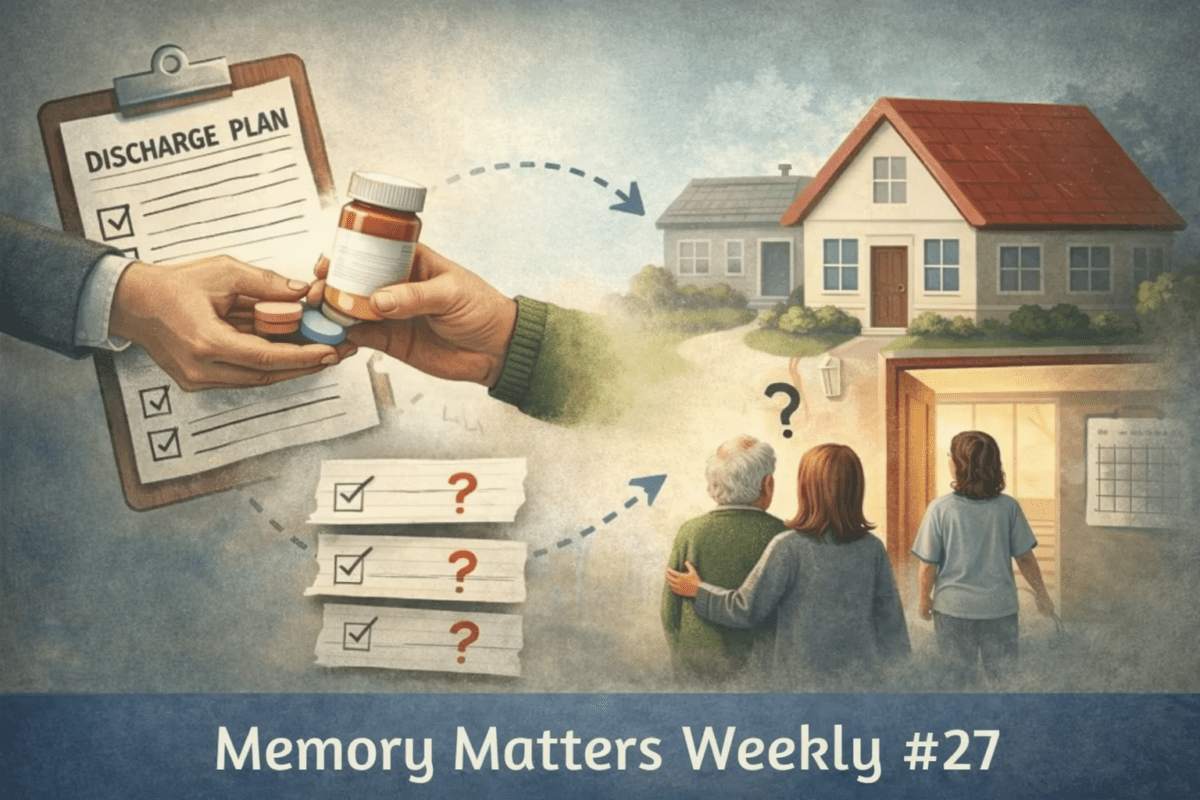
Leaving hospital is hard for anyone, but even harder when leaving a mental health ward. For someone living with dementia, it can be one of the most disorienting points in their care.
It’s either taken a lot of time to get to this point, or it feels rushed like nothing is properly in place, and the burden now falls on the family or the person with dementia to pull everything together, to bridge that gap between the ward and home.
You feel like medication changes don’t get explained properly, or decisions get made without the person being genuinely involved. You arrive home with a discharge letter half-understood, into a situation you’re not really prepared for. And weeks later, bigger problems emerge or people end up back in hospital, simply because the handover wasn’t good enough.
Researchers at the University of Manchester have spent time looking closely at this problem, and the findings published in the BMJ Open describe something they’ve built to try to fix it.
It’s called SAFER-Dem, a structured discharge tool designed specifically for people leaving mental health hospitals with dementia.
What makes it different from previous attempts is how it was made. They didn’t design it in a room and hand it to patients. They ran workshops and interviews with 29 people, people living with dementia, unpaid carers, and ward staff, who tried out early versions, said what didn’t work, and shaped what it eventually became. The people who live this experience built the tool alongside the researchers. That sounds like it should be standard practice. It mostly isn’t.
What those participants described was a discharge process that regularly lets people down. Rushed communication. Confusing medication information. Busy ward environments that are hard to navigate at the best of times, let alone when you’re cognitively vulnerable. Families are expected to carry information between services because nobody else is doing it consistently. People with dementia are not properly included in conversations about their own care.
SAFER-Dem tries to address all of that.
It is not an app or a piece of technology. It is a framework that helps staff, patients and families make sure the right conversations happen, in a way that is actually understandable.
The aim is simple, but important. To make discharge clearer, more joined up, and more inclusive. That includes:
• Making sure the person with dementia is involved in conversations in a way they can follow
• Explaining what is happening next in plain language
• Going through medication changes properly
• Coordinated planning between hospital and community services before discharge
• Involving families & caregivers early, not at the last minute
Participants found the SAFER-Dem approach more inclusive. More structured. And closer to how dementia care actually needs to work outside hospital.
The research is still at an early stage and focused on mental health hospital discharge. 29 participants in the workshops is enough to build and refine a tool, but not enough to prove it works at scale across different wards and different levels of dementia severity.
The researchers are clear that it doesn’t fix everything. But the problem it’s trying to solve is real and common, and it affects many families.
Discharge is not just a clinical handover. It’s the point where responsibility moves back to families, and if you’re not prepared or don’t have the right support, things can quickly deteriorate or impact daily life.
So if you’re facing a discharge in the near future, you don’t have to wait for a better system to exist.
- Ask for a written discharge plan before you leave the ward.
- Ask specifically about any medication changes and why each one has been made.
- Ask what community support has been put in place and who you call if something goes wrong once you’re home.
If it feels rushed or unclear, you are entitled to slow it down and ask for more.
Source: ‘New tool helps people with dementia transition from hospital to community’ NIHR, 2 April 2026 • Read it here
In Other News
Could Your Genes Change How Meat Affects Your Dementia Risk?
A long-term study following over 2,000 older adults found that meat consumption was linked to slower cognitive decline and lower dementia risk only in people with certain APOE gene variants, which are already associated with higher Alzheimer’s risk.
This was not a general finding for everyone. The association was specific to those higher-risk genetic groups, and the study was observational, so it can’t prove cause and effect or show that meat directly protects against dementia.
It suggests diet may work differently depending on your genetic risk. It also found that a higher proportion of processed meat was linked to worse outcomes, regardless of genetic profile.
Source: ‘Eating more meat may lower Alzheimer’s risk for some people’ ScienceDaily, 1 April 2026 • Read it here
Vitamin D in Your 30s and 40s May Affect Your Brain Decades Later
Researchers followed nearly 800 participants from the Framingham Heart Study for around 16 years. People who had higher vitamin D levels in their 30s and 40s were found to have lower levels of tau, the protein that forms damaging tangles in Alzheimer’s disease, when their brains were scanned years later. Around a third of participants had low vitamin D levels at the time of their blood test.
This doesn’t show that vitamin D prevents dementia, but it does point to something important. Changes in midlife may influence what is happening in the brain years later, long before symptoms appear.
Source: ‘Higher vitamin D levels may be linked to lower levels of Alzheimer’s biomarkers’ University of Galway, April 2026 • Read it here
Read more here → About Khadra Awomer’s dementia caregiver journey